
This winter and next are shaping up to be some of the most promising years for seeing the Northern Lights in the UK in over a decade, thanks to heightened solar activity and a run of strong aurora events. With that in mind, we’ve created this practical, no-nonsense guide — complete with a visual interactive map — to show you exactly how, when and where to go to give yourself the best possible chance of seeing the aurora from home soil.
Believe it or not, you don’t need to book a flight to Scandinavia to see the Northern Lights (scientifically known as the ‘aurora borealis’).
If luck is on your side – plus obsessive checking of the weather forecast and moon cycles – you can jump on the next train and head into the depths of the British countryside for a glimpse of the world’s best natural light phenomenon.
That said, the Northern Lights are not visible everywhere. The best places to see the Northern Lights in the UK are, as the name suggests, up north, and at a location with wide open skies and no light pollution. It’s no easy feat to see them, but when it happens, it’s a bucket list natural wonder you’ll simply never forget.
Interested in chasing the lights this season? Here’s our complete guide on everything you need to know about when to go, where to base yourself, and how to give yourself the best possible chance of seeing the aurora without booking a flight to Norway.
When’s the Best Time to See the Northern Lights in the UK?
The Season
In the UK, the aurora borealis season runs from late September through to late March. These are the months when nights are long enough and dark enough for faint auroral light to actually be visible.
That said, the strongest months tend to be October to February, simply because:
- The nights are properly dark
- You get more hours of potential viewing
- Cold, clear winter high-pressure systems often bring better skies
We’re also currently in a solar maximum, meaning the sun is more active than usual. In simple terms: the next couple of winters (including 2025–26) give us better-than-average chances of seeing aurora from the UK. Our luck is in!
The Best Time of Night
If you don’t fancy standing on a headland all night, aim for the 10pm to 2am window. That’s when auroras most often show up in UK skies. They can appear earlier or later, but this is your most reliable four-hour stretch.
Why the Moon Matters (Almost as Much as the Sun)
A bright full moon can easily wash out a weak aurora. For the best chance, plan your trip around the new moon, when skies are at their darkest.
If you’re thinking about a winter aurora trip at the end of 2025 and start of 2026, these are the key new moon dates to build your itinerary around:
- 21 September 2025
- 21 October 2025
- 20 November 2025
- 20 December 2025
- 18 January 2026
- 17 February 2026
- 19 March 2026
You don’t need to hit the exact night — a few days either side still gives you lovely dark skies. The main thing is avoiding that glaring full moon.
The Best Places in the UK to See the Northern Lights
Now that you know the ‘when’, it’s time to know where.
We’ve rounded up some of the best places that give you a strong chance of seeing the aurora borealis when the conditions are right.
1. Scottish Highlands & the North Coast 500
The best all-round bet
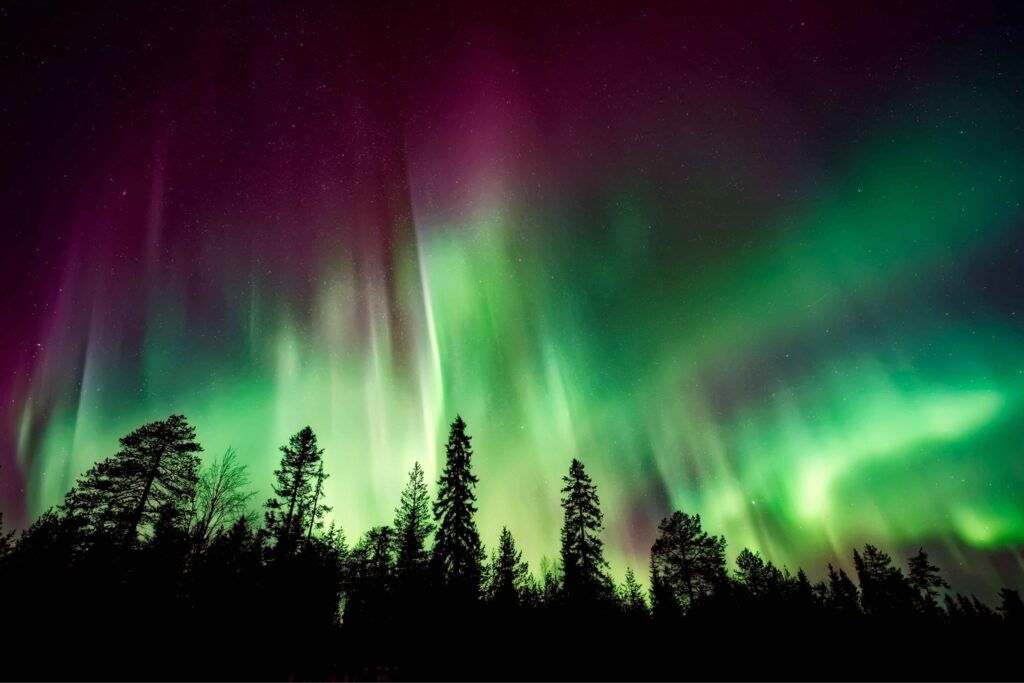
If you only pick one region in the UK to chase the Northern Lights, make it the far north of mainland Scotland to the Highlands and around the NC500 – Scotland’s most famous scenic road trip route.
This is basically as close as you can get to the Arctic without leaving the UK, with vast areas of almost zero light pollution, long winter nights, and huge, uninterrupted horizons looking straight out over the North Atlantic.
The combination of high latitude, dark skies and exposed coastline gives the Highlands some of the most consistent aurora visibility in Britain when solar activity ramps up.
Best places to go:
- Durness & Tongue – right on the north coast with wide open sea views
- Thurso & John o’ Groats – surprisingly good on a clear night
- Assynt & the Stoer Peninsula – wild landscapes and almost no artificial light
- Wester Ross coast (Gairloch, Shieldaig) – brilliant northern horizons over the water
Best base towns:
- Inverness – the easiest base if you want flexibility and decent food options
- Ullapool – small, friendly, and right on the edge of proper darkness
- Thurso or Durness – remote, rugged, and ideal if aurora is your main mission
Scotland regularly sees the strongest UK aurora displays during big solar storms. On the right night, the lights can stretch right across the sky. Whilst you’re there, you’ll be spoilt for choice for outdoor adventures to do during the day.
2. The Isle of Skye
For dramatic foregrounds and sea reflections
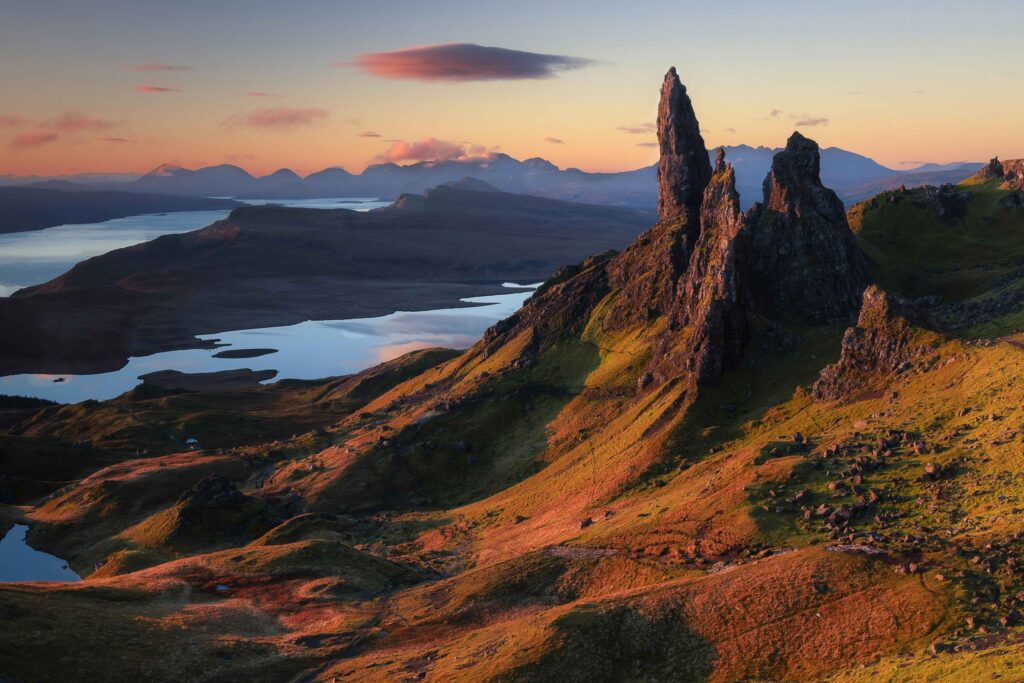
Image credit: Sue Jones via Pexels.
Skye is already ridiculous by day. At night, when the aurora borealis turns up, it’s borderline unfair on photographers elsewhere in the country.
Skye sits far enough north to benefit from strong aurora activity, but it’s the island’s lack of urban light, wide sea horizons and wildly sculpted landscape that really elevate the experience.
Once you’re away from Portree’s glow, the darkness is deep and the views north and west open straight onto the ocean.
When the lights appear here, they often reflect in the sea beneath jagged ridgelines and sea cliffs – turning an already dramatic island into something that feels slightly unreal.
Great viewing spots:
- Neist Point – endless ocean to the north and west
- Staffin Bay & the Trotternish coast
- Quiraing viewpoints on quiet nights
Best base towns:
- Portree – easiest for accommodation and food
- Broadford – handy if you’re arriving late or want faster mainland access
Skye’s weather is absolutely chaotic, so flexibility is key. If skies clear during an alert, it’s one of the most atmospheric places in Britain to be standing at midnight.
3. The Outer Hebrides (Lewis, Harris & the Uists)
Dark-sky heaven
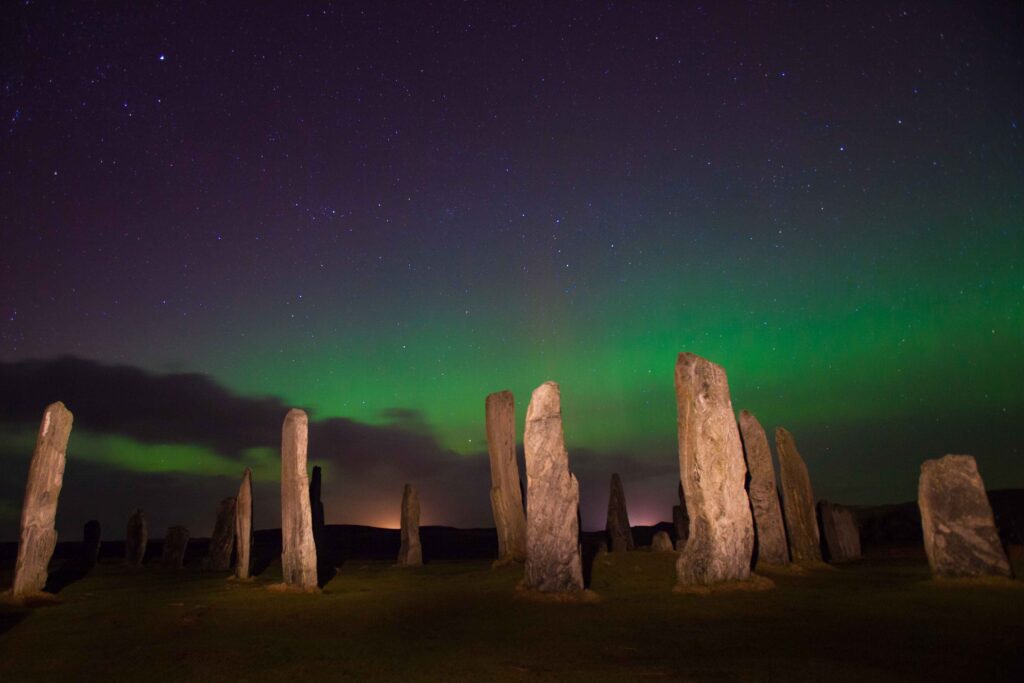
Image credit: RichardALock via Getty Images.
If your idea of a perfect aurora chase involves maximum darkness, minimal people and a lot of wind, the Outer Hebrides in Scotland deliver.
The Outer Hebrides are one of the darkest inhabited places in the UK, and that darkness is exactly what makes them so powerful for aurora watching.
With little artificial light, wide Atlantic horizons, and long winter nights, the islands offer some of the cleanest, uncluttered night skies you’ll find anywhere in Britain. When aurora appears here, you’re often watching it from a silent beach with nothing but sea, stars and sky around you
Top spots:
- Butt of Lewis & Tolsta on the north coast of Lewis
- Luskentyre Beach (Harris) for insane reflections on calm nights
- North & South Uist beaches for sheer isolation
Best base towns:
- Stornoway (Lewis) – transport hub, shops, and easy access to dark beaches
- Tarbert (Harris) – good middle ground between comfort and wildness
These islands get fewer casual visitors in winter, but if the weather and ferries play ball, they offer some of the best aurora odds in the UK.
4. Northumberland & Northern England
When the sun is really having a moment

Image credit: Jonny Gios via Unsplash.
When strong solar storms push the aurora further south, Northumberland becomes England’s best place to be. Sometimes it can also be spotted in neighbouring Cumbria.
The county of Northumberland combines protected dark skies, exposed North Sea coastline and easy access to wide northern horizons, which gives it a serious edge over most of England. It’s also home to Europe’s largest Dark Sky Park, meaning that even faint auroras have a fighting chance against the darkness here.
Best places:
- Bamburgh, Seahouses & Embleton – beaches with big northern horizons
- Holy Island (Lindisfarne) – if the causeway is open and skies are clear
- Kielder Forest & Reservoir – full-on dark-sky immersion
Best base towns:
- Alnwick – great for both coast and countryside
- Bamburgh & Seahouses – aurora beach walks straight from your door
- Bellingham – ideal for Kielder nights
On truly exceptional storms, faint aurora has even been spotted from the North Yorkshire Moors, but usually as a red or pink glow low on the northern horizon.
5. Northern Ireland: Antrim & the North Coast
Quietly excellent on big nights

Image credit: Jon135 via Getty Images.
Northern Ireland often flies under the radar for aurora watching, but the north-facing Antrim coastline, combined with relatively low light pollution and clear sea horizons, gives it real potential when activity is high.
During strong solar events, the lights can spill across the North Channel and become visible from dark coastal headlands, beaches and cliff-top viewpoints — often with far fewer people around than you’d find in popular Scottish spots.
Best areas:
- Antrim Coast Road
- Giant’s Causeway & Dunluce Castle area
- White Park Bay, Ballintoy & Murlough Bay
Best base towns:
- Portrush & Portstewart – lively enough to enjoy by day, great coastal access by night
- Ballycastle – quieter and closer to darker stretches of coast
On strong solar nights, Northern Ireland often punches well above its weight. Plus there are plenty of outdoor activities to do whilst you’re waiting for the sun to set.
UK Northern Lights Interactive Map
To visually explore the best places to see the northern lights in Britain, we’ve created a handy interactive map to play around with. Just select a pin to bring up the destination information and see how far away it is from you by selecting the ‘Get Directions’ button.
Essential Aurora Resources (That Actually Help)
If you’re serious about seeing the lights, these Northern Lights resources are worth bookmarking:
- AuroraWatch UK – UK-specific alerts (green, yellow, red)
- Met Office Space Weather Forecast – solar activity explained in plain English
- My Aurora Forecast app – handy for quick checks
- Any cloud-cover apps (Met Office, Windy, XCWeather) – arguably the most important of all!
Checking cloud cover is often more useful than obsessing over geomagnetic numbers. There’s nothing worse than getting out there only to have a spectacular show hidden behind a thick curtain!
Practical Tips for UK Aurora Chasing
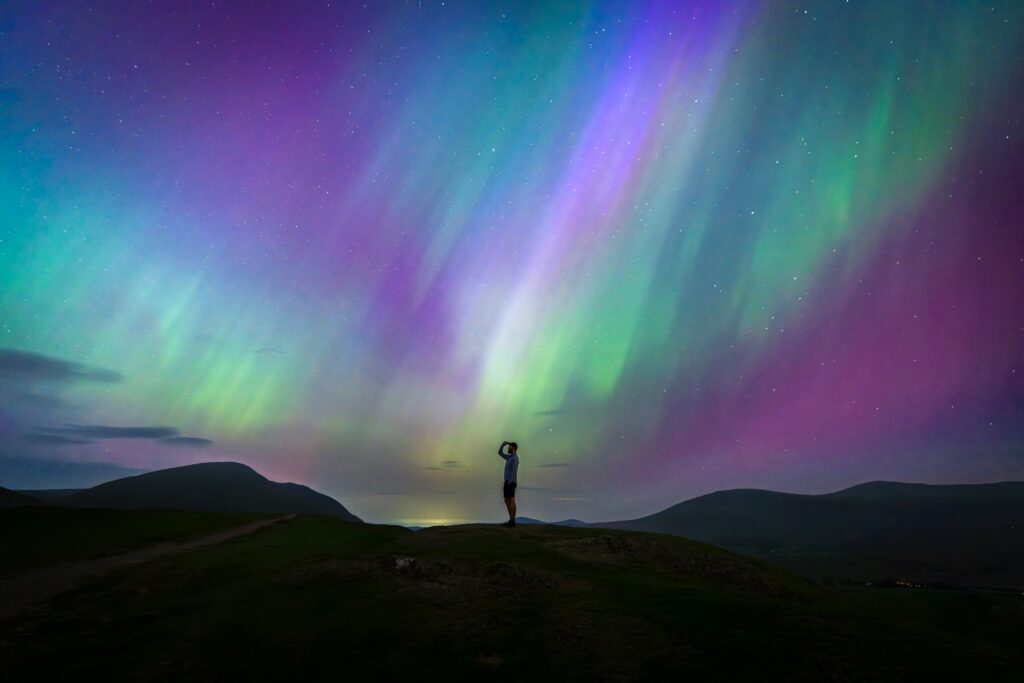
Catching the Northern Lights in the UK is certainly no easy feat — nature is wild and unpredictable, and the lights rarely appear on demand. But don’t leave it entirely to fate. If you’re willing to brave the elements, here are the essential tips to give you the best shot at seeing the sky dance:
- Face north. Most UK auroras sit low in the northern sky.
- Get away from town lights. Even small villages can ruin faint displays.
- Be patient. The lights can fade in and out over hours and clouds can come and go.
- Don’t trust your eyes alone. Cameras often pick up colour before you can see it clearly – use a tripod and a long exposure setting.
- Use your phone as a scout. Modern smartphone sensors are surprisingly sensitive. If you aren’t sure if a grey smudge on the horizon is cloud or aurora, snap a quick photo using ‘Night Mode’ to reveal if there is a green glow hiding
- Dress like you’re going for a winter camp, not a quick dog walk. Standing still at midnight in January is cold on another level.
- Protect your night vision. It takes around 20 minutes for your eyes to fully adjust to the dark, but only a split second of bright light to reset the clock. Use a red-light head-torch rather than white, and dim your phone screen to keep your vision sharp.
- Expect nothing, enjoy everything. Even without aurora you’ll get dark skies, stars, maybe the Milky Way — and the joy of being somewhere wild at an unreasonable hour.
The Honest Truth About Seeing the Northern Lights in the UK
It bears repeating again — you can do everything right and still go home empty-handed. That’s just part of the game. Aurora watching in the UK is a mix of timing, luck, cloud gaps and stubborn optimism.
But when it does happen — when a quiet northern horizon suddenly starts glowing green above a Scottish beach or castle or headland — it feels genuinely magical. And unlike Iceland or Norway, there’s something extra special about seeing it from home turf, on familiar ground.
Happy aurora hunting!
this was very helpfull to me i will be spending Christmas in Amble Northumberland this year with my daughter so Bamburgh beach will be close, looks like a , hopefully freezing cold clear night ahead.
Thanks for your comment Bill! I have everything crossed for you that all things will align for some Northern Lights during your Northumerland visit!