
Armed with a borrowed bike, a soft spot for Romantic poets, and a vague hope for wild inspiration, Philip set out to find the legendary Byron’s Pool. What he found instead was a small stretch of muddy riverbank, some sleepy woods, and a confrontation with the gap between literary lore and springtime reality. Still — cows, meadows and a cracking pint at the pub after made it a very Cambridge sort of day.
It was the week of spring equinox when I hopped on my borrowed bike and cycled along the unseasonably sunny lanes of Cambridge until I reached the even more picturesque fields of Grantchester.
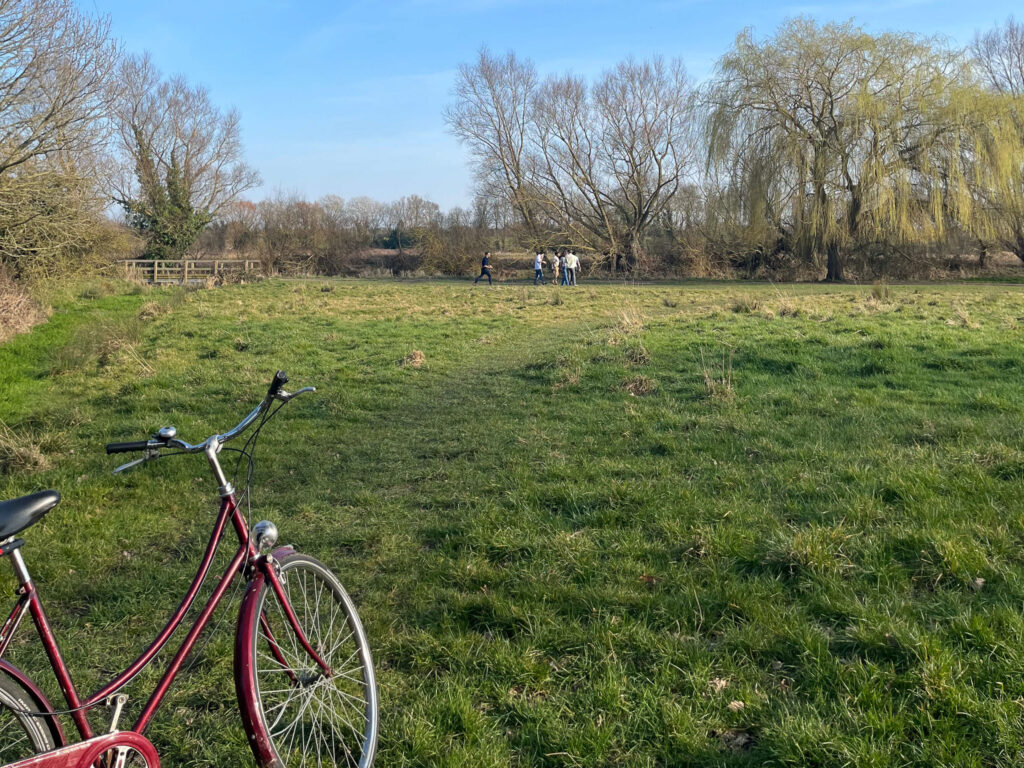
There, I was greeted by wide open meadows, full of the squeals of students as they leapt repeatedly into the river. Between the groups of boisterous young folk, cows wandered aimlessly, adding to the general idyllic vibes.
Though it was only mid-March, the day was warm and the surface of the water glittered invitingly. I was tempted to just lie down in the grass and pull out my book. But no, my destination was a little further along the path. A spot famous for its literary history and (hopefully) its natural beauty as well. Byron’s Pool: the haunt of skinny dipping writers for over 200 years. Surely that was worth searching for?
Well, it was. But only just.
Grantchester Meadows & Byron’s Pool Key Stats:
- Length: The pool is about 3 miles (4.8 km) southwest of Cambridge.
- Duration: From the centre of Cambridge, it’s around a 90 minute walk through Grantchester Meadows and beyond. 30 minutes if on a bike.
- Difficulty level: Easy and pleasant.
- Type: Point-to-point.
- Start/end location: Cambridge City centre (market square)/ Byron’s Pool.
- Elevation gain: Negligible – it’s pretty flat
- Terrain: Well-formed footpaths, grassy meadows and narrow streets.
- Accessibility: Mostly suitable for wheelchair users and those with limited mobility. Some parts of the woodland have very uneven and muddy ground.
The Romantic Connection: Lord Byron and the Pool

Byron’s Pool is classic Cambridge. It somehow embodies my experience of life in the city itself. Esoteric, beautiful and safe, but ultimately, a little underwhelming.
The pool takes its name from Lord Byron, one of the most famous poets of the Romantic era, who is believed to have swum in this section of the River Cam during his time at Trinity College, Cambridge (1805–1808).
Byron was an early example of what we might now call a ‘bad boy poet’. His rebellious spirit and fondness for the outdoors affected much of his life and work. Like many Romantics, he drew inspiration from nature and was apparently a great lover of animals. One story has him keeping a bear as a pet in his Cambridge rooms (as dogs were not allowed).
As for the pool, it’s hard to find any hard evidence of when and why Byron actually swam here, but local tradition and literary history have linked the spot to him. And I can well see why.
The poetry of the Romantics is all about the importance of beauty, solitude, and the act of immersing oneself – both literally and metaphorically – in the natural world. So the idea of the poet stripping off and leaping into the pool under a moonlit sky does hold a certain, je ne sais quoi.
But though the pool bears his name, Byron was not the only wild writer to be associated with the spot.
Rupert Brooke, the early 20th-century poet, lived in Grantchester and wrote about the village’s idyllic setting.
Then there’s the Grantchester Group, which included figures such as Virginia Woolf and E.M. Forster, who often met at The Orchard Tea Garden (just down the road from the pool).
Ted Hughes, another ‘bad-boy poet’, also allegedly swam here with the equally wild Sylvia Plath during their Cambridge days.
The Modern Reality: Cold, Muddy and Dull

This all sounds delightful, but what about the pool today?
Well, my initial excitement was sustained as I made my way along the Grantchester path on that sunny day. The narrow road ran along the meadows before snaking through the village itself, passing two pubs and the aforementioned Orchard Tea Garden.
But to find the pool, I had to continue on a little further until I reached the edge of the next village: Trumpington. Between the two is a long strip of woodland parallel to the river, with fields on either side, called – you guessed it – Byron’s Pool Local Nature Reserve.
I locked my bike in the woodland car park and set about exploring. And this is where the excitement began to wane. It didn’t take long to see all there was to see.
Yes, the concentration of biodiversity in this patch of semi-wilderness was very inspiring. Signs informed me that the canopy was made up of a healthy mix of Beech, Hornbeam, Ash, Wych Elm, Pedunculate Oak, riverside Willow and Field Maple. Also, the wood was apparently home to a variety of fungi and wildlife, including Banded Demoiselle Damselflies, Great Spotted Woodpeckers, Kingfishers and Arched Earthstar mushroom.

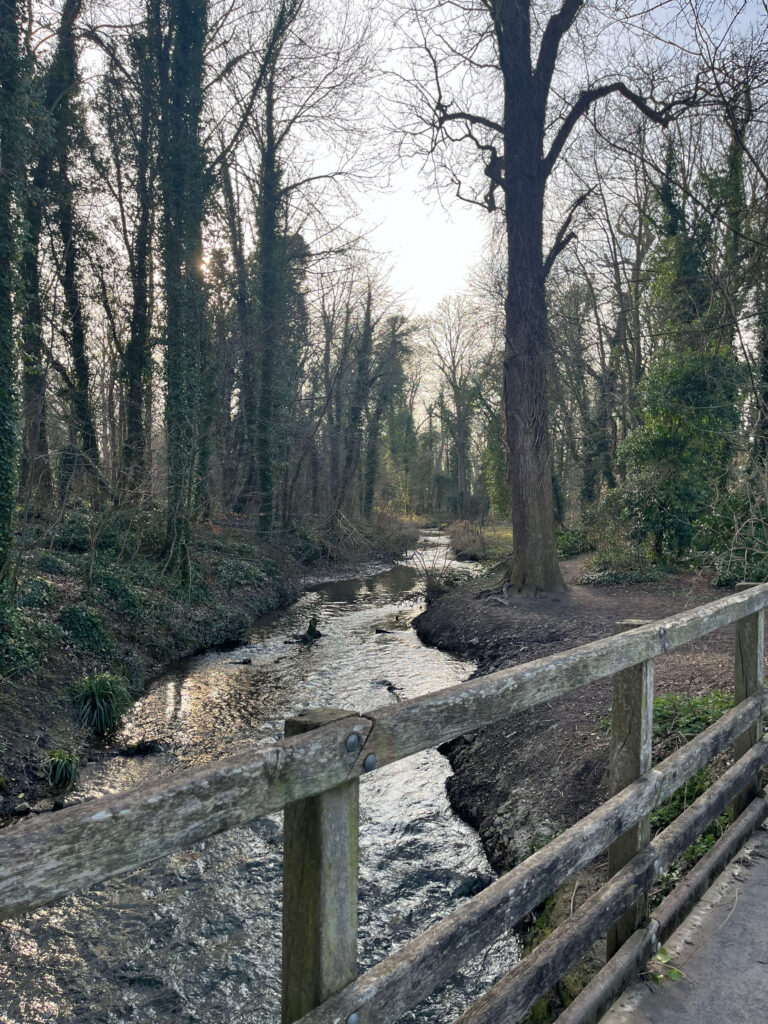
However, while the woodland was beautiful, it was also very small – basically just two or three paths or about 15 minutes of easy strolling. And, it was very much the wrong time of year to enjoy it. Sure, in summer or even autumn the wood was almost certainly a beautiful place for a picnic, a dog walk or (dare I say?) a wild swim. But on that equinox afternoon, spring was only just beginning, and the trees were bare and sleepy.
Finally, there is not one pool, rather there are a series of potential pools along the river, with small platforms built into the bank for fishing or canoeing.
I stood on one of these platforms and looked around, weighing up my desire to swim with the realities of the moment.

The sun was shining through the branches and the birds were singing fit to burst, but the wind was cold, the water was muddy and – most important of all – poetic inspiration completely failed to push me into a state of wild rapture.
The sunlit nostalgia surrounding Byron’s Pool met the muddy and chilly reality of mid-March head-on.
What I’m saying is: I didn’t swim.
The Rise of Wild Swimming & the Risk of Pollution
It’s a shame I didn’t swim, because this stretch of river is generally considered to be clean and safe to swim in, at least compared to other parts of the UK.
It’s fascinating to me, though perhaps not surprising, that the modern rise in wild swimming has come hand-in-hand with a greater concern for English rivers. The Great British ‘sewage scandal’ really is a sickening state of affairs, in all meanings of the word.
In case you’re not up on the grim news: widespread discharge of untreated sewage, together with industrial and farm runoff, mean that only about 14% of UK rivers are safe to swim in. Though of course this figure changes all the time depending on the weather and what the water companies have been up to lately.
For their part, the water companies blame inadequate infrastructure and insufficient investment, while activists say it’s the fault of weak or non-existent regulations.
Whatever the reason, it’s all rather heartbreaking, as wild swimming is a balm for both body and mind. Not only is it great exercise, the cold water also shocks your thoughts into focus and grants psychological relief. It’s something I’d highly recommend if you’re struggling with a problem or just need to get out of your head for a bit. Plus, it’s one of the best ways to experience the true, unfiltered beauty of the natural world while reconnecting with your deeper self.
If you are considering a wild swim, or want to get more involved with the fight for clean rivers and coastlines in the UK, be sure to check out Sewage Data HQ, which gives up-to-date water quality information on rivers and coastlines.
The Rivers Trust and River Action UK are two great organisations fighting to make rivers clean again!
Finally, if you’re in Cambridge and keen to do some wild swimming, maybe take a look at the Cambridge open water swimming Facebook group.
Final Thoughts on Byron’s Pool

It was early evening and the sun was dropping behind the trees when I stopped in the Green Man pub in Grantchester to consider the day’s adventure.
While I was disappointed I hadn’t been compelled to swim, I still felt that Byron’s Pool was a beautiful place to experience.
My advice would be don’t go expecting anything other than what it is: a thin stretch of river and woodland, sandwiched between fields.
If nothing else, the history of the pool and biodiversity of the woodland are a strong draw for the ecological or literary-minded among you. Especially if, like me, your true interests lie in the combination of those two things. Something which the Romantics did better than most.
And yes, you may find you made the trip in vain if you were hoping for an ecstatic swimming experience or some kind of poetic inspiration, but I like to believe that even a wasted trip is an adventure worth having.
As the poet himself said: “A man must travel and turmoil, or there is no existence.”
Tips for Visiting Grantchester Meadows or Byron’s Pool:
- Stop in Grantchester Green Man pub for a drink (or lunch).
- Be sure to check out The Orchard Tea Garden (though beware the extortionate price of scones).
- If you’re going to Byron’s Pool, don’t expect privacy. It’s a small wood and likely to be very busy in good weather. The meadows, on the other hand, are huge and full of cosy spots for a picnic or a swim.
- As I said, the river is mostly safe to swim in, but do some research and be aware of the risks. Also, I’ve known people to step on broken beer bottles in the bottom of the river, so be warned.
- I dare you to read some Byron before, or even during, your visit. ‘There is a pleasure in the pathless woods‘ – is a good place to start.
All photos are credit to the author. No unauthorised use.