
It’s baffling that you can walk on a beach, casually find a fossil and hold millions of years of history in your hand. Then to realise that you can take that piece of history home with you… No wonder Philip found fossil hunting in Lyme Regis a truly eye-opening and nostalgic adventure.
The first time I went to Lyme Regis, I didn’t really know what I was doing. As with many of my adventures, I went on a whim. And while this style of impromptu travel can certainly yield fun and unusual results, in the case of fossil hunting in Lyme Regis, I do wish I’d done a little more research beforehand.
Hence this article, which will hopefully help you to enjoy the wonders of this part of the world just as much – or even more – than I do.
An Adventure 65 Million Years in the Making
I was barely a year old when Spielberg’s Jurassic Park hit the screens with the force of a particularly monumental stegosaurus.
I can still remember the first time I saw the famous ‘water-shaking’ scene. I leapt from the sofa and dashed behind the closest adult, filled with a mix of dread and fascination, as the massive shape of the T-Rex roared into view.
Like many of us, I’ve been in love with dinosaurs ever since.
Thirty years later I was amazed to find myself strolling along the sunny shores of South Devon with a pocketful of ammonites and a small hammer in my hands, looking for one thing and one thing only – dinosaur bones.
Say what you like about the film and its many sequels, it’s impossible to deny it had a powerful impact on our collective imagination. The very idea that these majestic monsters once walked our tranquil shores, fens and forests is a thrill to consider.
But few Brits know that the UK holds one of the most abundant and unique bone sites in the world.
And even fewer know that you can just pick them off the beach. For FREE – sort of… We’ll get to that.
First let’s jump into the Jurassic Coast. What it is, where it is, and why you need to get down there with a hammer and a wheelbarrow as soon as possible.
England’s Only World Heritage Site

Image credit: Matthew Gibson via Getty Images
The Jurassic Coast is England’s only natural World Heritage Site. This means it’s up there beside global natural wonders like the Great Barrier Reef and the Grand Canyon.
It stretches all the way from Exmouth, in East Devon, to Old Harry Rocks, in Swanage, Dorset. Roughly a hundred miles of dramatic cliffs, secluded coves and barrier beaches, full of the fossilised bodies of long dead monsters and all manner of interesting archaeological and geological wonders.
In fact, it’s the only place in the world where 185 million years of the Earth’s history can be observed in the segmentation of the rocks.
It provides an utterly unique ‘walk through time’ as you move eastward along the site, passing the Triassic, Jurassic and Cretaceous periods.
If this is all sounding a bit sciency and esoteric, don’t worry. I’m in no way a hardcore fossil collector. My technical knowledge of dinosaurs pretty much begins and ends with Yoshi from Mario Kart. Yet I still had an excellent time trawling through the cornucopia of rocks, petrified footprints, and other geological marvels on offer along the Jurassic Coast.
Still, if you’re hankering for some backstory, I’ll throw you a bone.
A Brief History of a Long, Long Time Ago

While you may not think it, Britain boasts one of the best dinosaur records in the world.
The first person ever to name and categorise a dinosaur was Oxford theologian and geologist William Buckland in the early 1800s. Of course, he didn’t really know what he’d found. Being a theologian in the nineteenth century, he believed the Earth was relatively young, and so thought this must be one of the many mysterious creatures that drowned in the Biblical flood.
Nevertheless, his work on the creature he dubbed the Megalosaurus – simply meaning ‘big lizard’ – began the long slow process that eventually led to the multi-billion-dollar Jurassic Park franchise we all know and love today.
According to the Natural History Museum, there were more than twenty species of dinosaurs that once called this little sliver of land – now called Britain – home.
These ranged from the spiky Hylaeosaurus ‘woodland lizard’ to the aforementioned ‘big lizard’ Megalosaurus, who at 6 metres long, wasn’t even that big for a dinosaur. Not when compared to the Pelorosaurus ‘monstrous lizard’, who was a mighty 25 metres long. That’s about as big as a blue whale, the largest creature that ever lived. Imagine that strolling past your local Greggs.
What makes the Jurassic Coast so extraordinary is that the cliffside very clearly – and beautifully – reveals three distinct time periods which collectively make up the Mesozoic Era, which ran from around 250 to 65 million years ago.
These three layers are ‘squashed’ together on the open rock like the layers of a sliced onion. And among those oniony layers, treasure can be found.
The Seaside Town of Lyme Regis
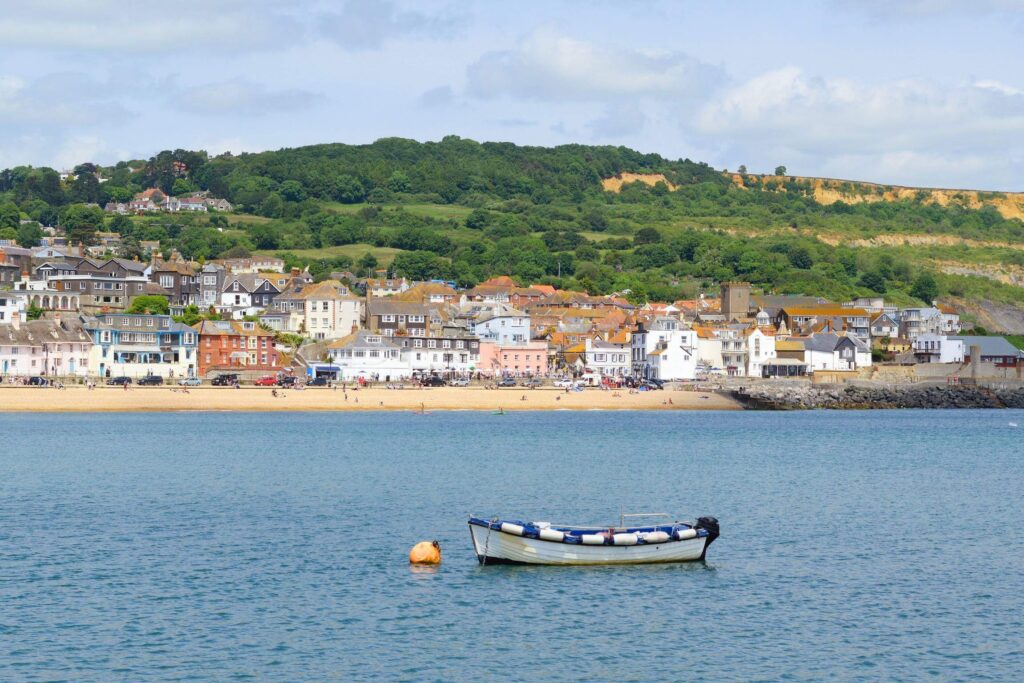
Image credit: savoilic via Getty Images
Speaking of treasures, let me get back to Lyme Regis. Also known as the ‘Pearl of Dorset’, this dreamy little town is one of those rare places that makes you think you’ve walked into a good-natured folk tale.
The streetlights all have cool ammonite designs, the streets are interwoven with tiny rivers and well-tended flowerbeds.
While there is a distinct, and justified, aversion to the hordes of so-called “DFL’s” (Down From Londoners) who descend upon the coast every summer, I generally found the locals to be very friendly, full of advice and cracking stories.
One energetic fisherman told me about the days he and his mates used to row out to the rocks at high tide to pop the bigger fossils in the boat, as there was no other way to get them off the beach. When I asked what he did with them, he just grinned: “they look lovely in the garden.”
The Legacy of Mary Anning

A must-see whilst in Lyme Regis is the Museum of Mary Anning, the renowned yet much-maligned Victorian fossil hunter who discovered the first ever Ichthyosaurs, aka ‘fish lizard’.
Mary was a true trailblazer who made many interesting discoveries and observations over the years and helped inform new ideas about geology and evolution of the world.
However, due to good-old-Victorian prejudice around women and female scientists, she was barely acknowledged for her findings and generally ridiculed by many members of the scientific community at the time.
You may have seen the film Ammonite based on her story featuring Kate Winslet. But I’d advise anyone who’s interested to take a deeper dive than that, as the movie doesn’t quite do Mary Anning justice. At least, this was the general vibe of the residents of Lyme Regis, who replied with a lot of eye rolling and muttered complaints of “too much sex” when I asked about it.
The Mary Anning Museum stands on the site of her former home and first fossil shop. It offers a fascinating collection of items, fossils and information relating to Anning’s extraordinary life and discoveries. It’s well worth a visit.
Fossil Hunting in Lyme Regis – for FREE

Image credit: Pet Shaw via Getty Images.
Right, let me get to the apex of my little adventure.
While the quaint town of Lyme Regis with its pubs, people and awesome lampposts was certainly in part drew me to this corner of the UK, the real reason I came down was, of course, the coastline. And the fossils.
For easy, amateur fossil hunting in Lyme Regis, I was recommended Monmouth Beach, which is just beyond the promenade.
Honestly, it’s pretty hard to miss. In Lyme Regis, the streets more or less melt into the beach by themselves.
I’m sure there are other spots for the more veteran fossil-finder, but if you’re new to the game I recommend Monmouth. And when I say game, I mean game.
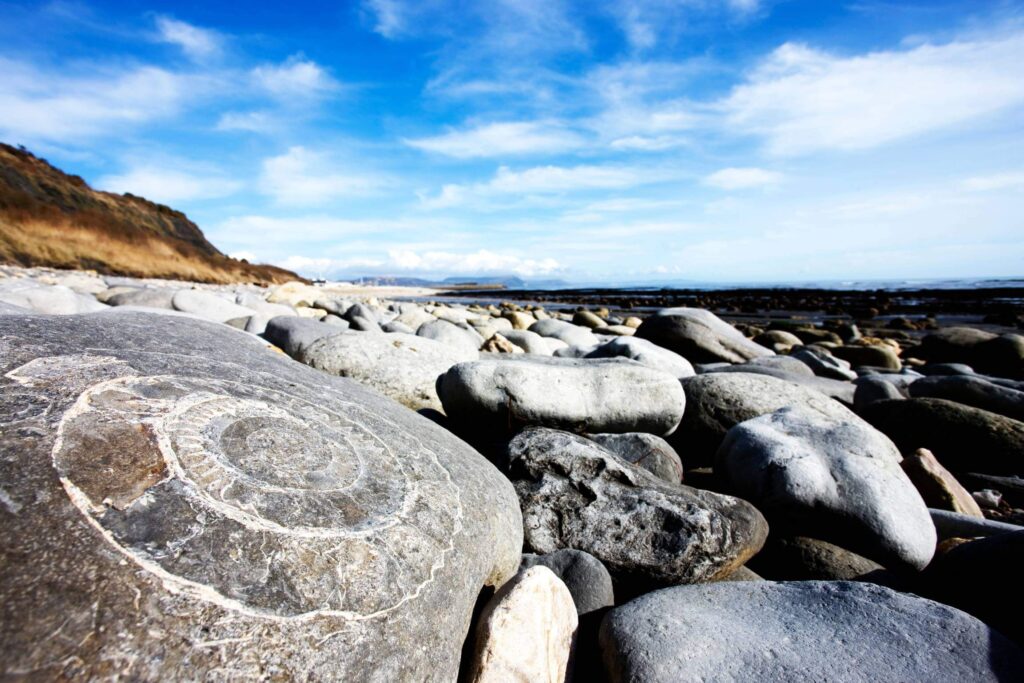
It didn’t take me long to experience the heart-thumping joy of finding my first ammonite, and then another. And another. It’s addictive.
These ancient natural Fibonacci masterpieces are literally lying around. You just pick them up.
Some are huge, as big as a Mini car, others are tinier than your smallest fingernail. It’s truly magical.
Of course, there are a few restrictions on this all-you-can-eat fossil feast. Nothing is ever THAT free. But in my experience, it was very relaxed. Just be sure to read up on the latest guidelines, as they change depending on weather for your own safety.
Once you master your excitement at this initial discovery, you can progress to the Next Level: cracking the rocks open with a small hammer – available at one of the many sea-side fossil shops. This opens up a whole new world of discoveries, and the elation only grows.
Combined with a beautiful sunny day, perhaps a wild swim in the sea and some fresh seafood from the pub, it’s easily one of the best ways to spend a day in the Great British Outdoors.
Plus, you’ll end up with some lovely garden ornaments which will remind you of a T-Rex every time you mow the lawn. Not bad.