
A short stroll on the popular Lord Stones Circular walk in the North Yorkshire Moors triggers musings on the surrounding human-impacted landscapes, and what a natural Yorkshire should really look like.
There’s something about Sunday strolls. Especially when, like a donkey trudging with a carrot dangling on a stick, there’s a hearty Sunday lunch waiting for you at the end of it.
One of my most local ‘walk and lunch’ spots is the 3 mile / 5km Lord Stones Circular Walk in the North Yorkshire Moors National Park, near Middlesbrough, ending at Lord Stones Cafe.
The 1.5 hour walk is extremely scenic, short and just energising enough to make you feel as though you’ve earned your meal, without tipping over to the point where you’ll start to fade.
The expansive views enjoyed on this walk are also thought-provoking for people like me, who are conscious of the way our landscapes are changing, and have been for centuries, due to human manipulation.
The Lord Stones Circular Walk: A Wonderful Panorama
Starting at the rear of the Lord Stones car park, I set off following the signs towards the Cleveland Way, soon passing the three majestic standing stones that define the perimeter of a Bronze Age burial mound.
The small ancient cemetery is set in a locale where traditional boundaries, pathways, and gathering spots have existed for several millennia.

At the first fork where a dry stone wall begins, I branch off to my left between a small cluster of trees. Soon I’m squelching on a muddy bridleway that cuts through the moorland, skirting my way slowly up the side of the hill.
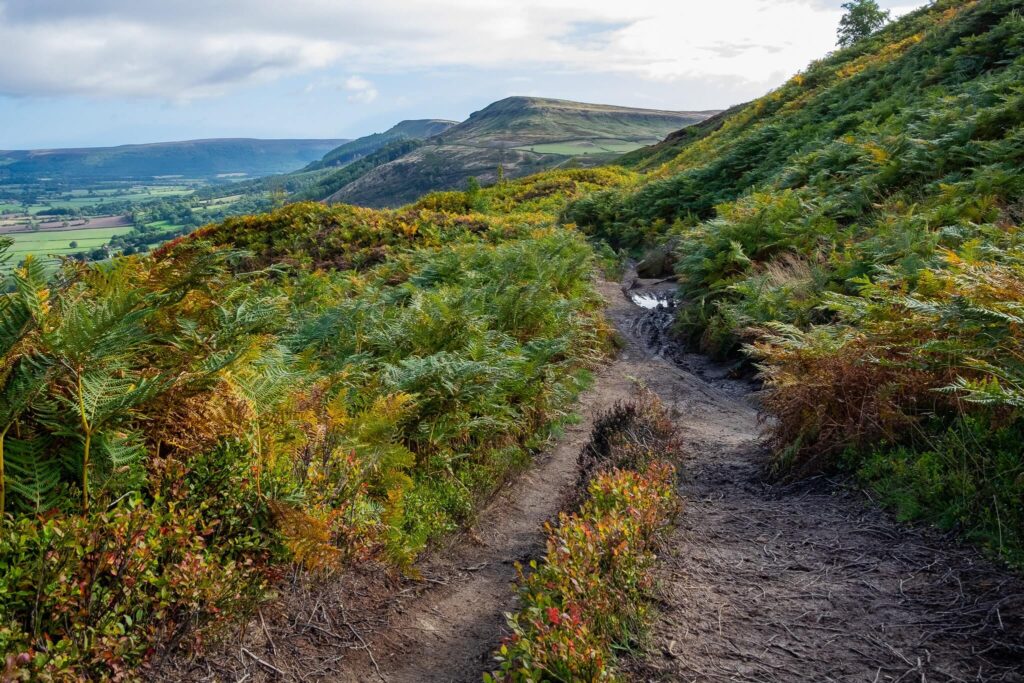
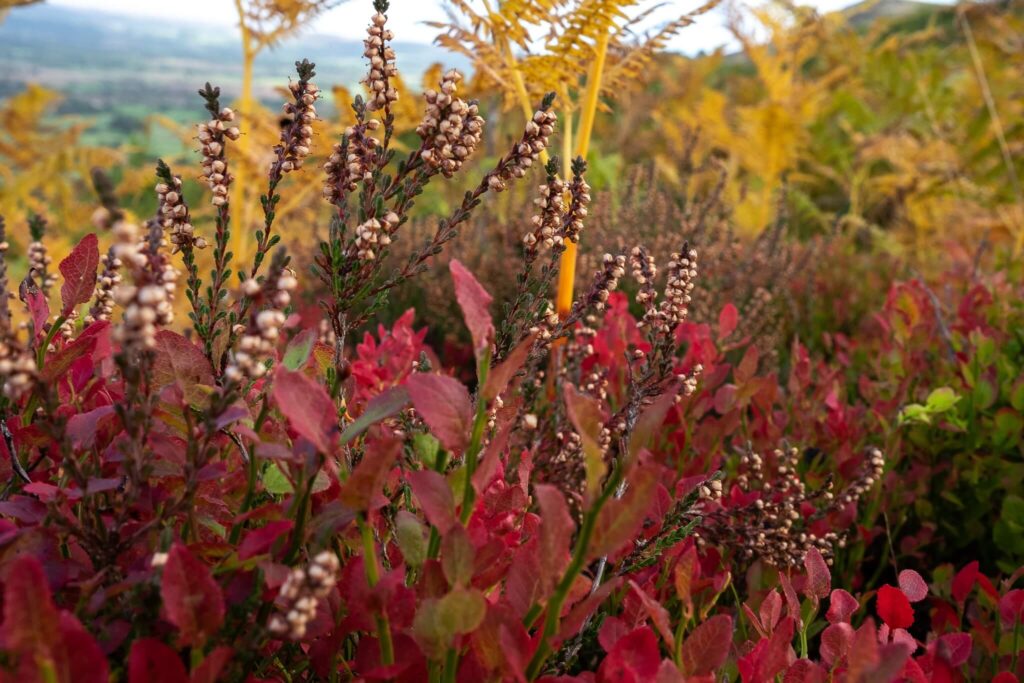
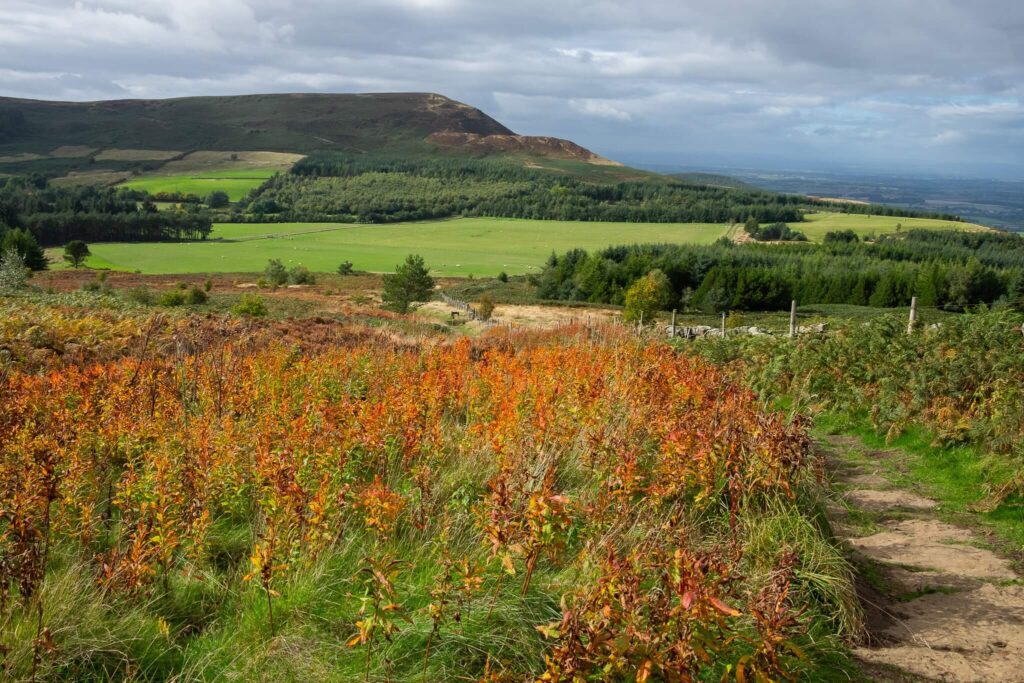
It’s a brilliantly sunny October afternoon. The heather is a dusky-pink, the ferns undecided whether they’re green, orange or red, and the sky a stunning vibrant blue. It’s an Autumnal colour eruption.
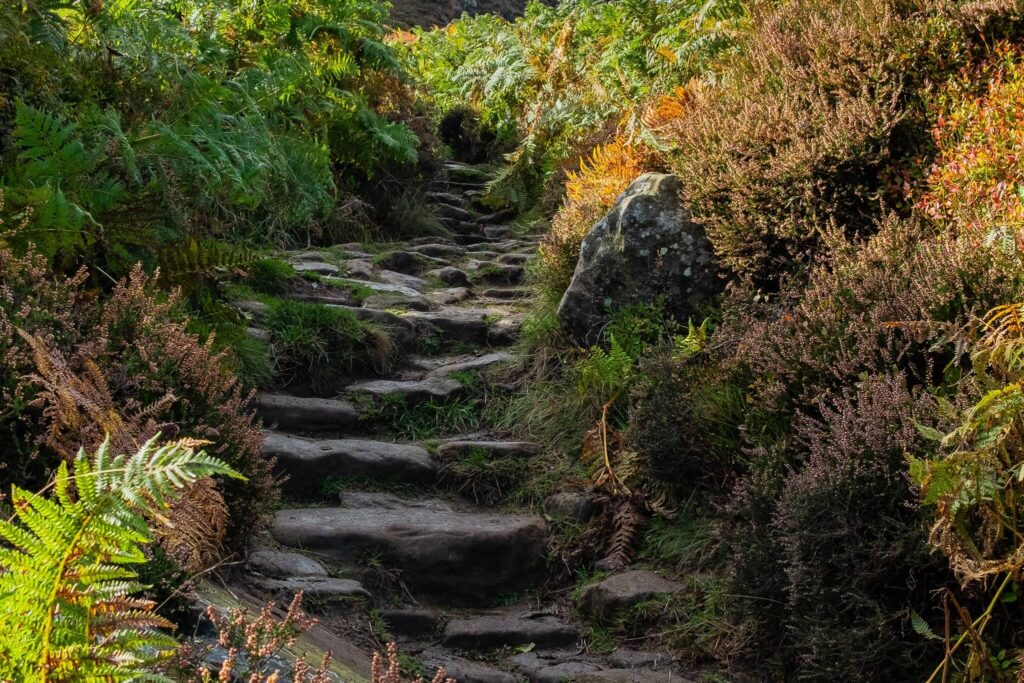
Before long, I hook a sharp right to rejoin the Cleveland Way, following steep rocky steps up to the back of Cringle Moor, the third highest hill in the North York Moors, standing at an elevation of 432m above sea level.
This part is probably the most challenging section of the short walk due to the gradient, but it’s only a few hundred metres. Plus a brief pause halfway up to catch your breath is not a bad idea if you turn around and look at the view behind you.
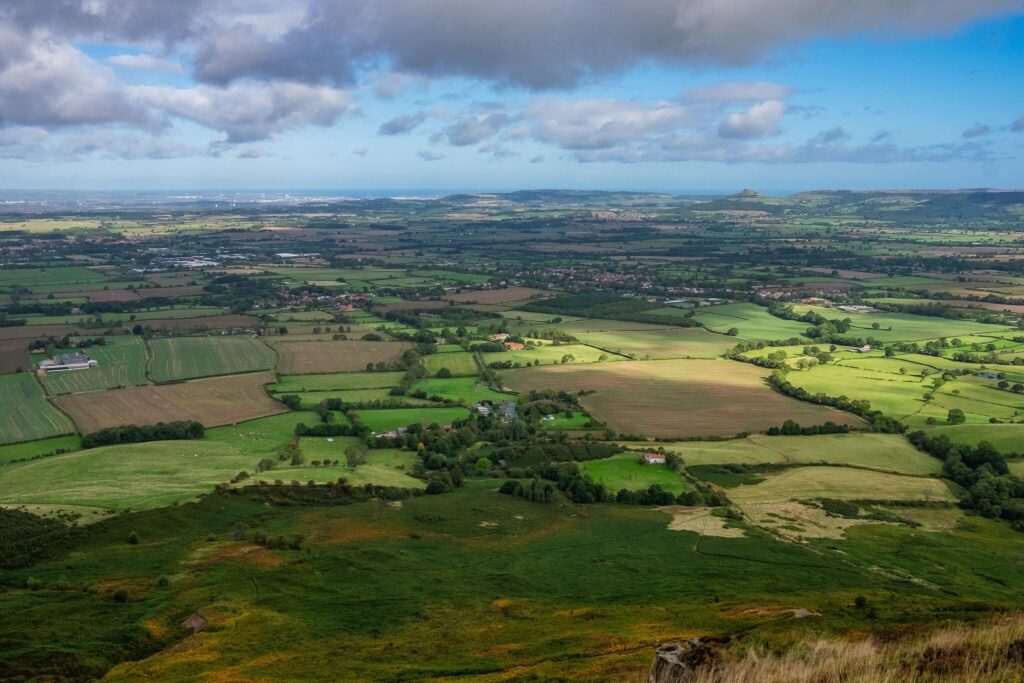
It’s a vast patchwork quilt of fields, sewn together by the odd row of trees or hedgerows, abruptly stopping at the northeast coastline.
Beyond there, the minuscule container ships hovered somewhere between sea and sky in a natural optical illusion.
Industrial Middlesbrough, noticeable being the largest urban cluster, billowed plumes of smoke. I imagined all the activities going on behind the scenes in those factories, like the mechanical model cities and the tiny imaginary inhabitants I once obsessed over as a child at Legoland Windsor.
A little more inland, the miniature villages of Great Ayton and Stokesley, which I know so well in full size, appear as nothing more than a housing estate for ants.
Roseberry Topping to the west, one of the area’s most iconic natural landmarks, a pimple protruding from an otherwise smooth complexion.
While this complex view from the top of Cringle Moor is undoubtedly breathtaking, and will never not be impressive for the sheer uninterrupted panorama, it was impossible to ignore the starkness of the endless, primarily flat jumble of fields that stretched out before me.
Natural Landscapes?
These fields, though beautiful in their own right, serve as a harsh reminder of really, how unnatural the landscapes here are. Ultimately – how sterile. Grass, ploughed earth, more grass.
We’ve been conditioned to romanticise fields of wheat and green pastures dotted with grazing cows.
And that’s not anyone’s fault. Farmland is simply emblematic rural UK because there’s simply so much of it. We’re proud to be a nation of farmers. The everyday heroes putting bread on our tables.
But really, what I should be looking upon in a native world, are huge swathes of woodland, wetlands, perhaps I would even spot a bird of prey of two hovering over the tree canopies. Not forgetting of course, a splattering of biodiverse mixed crop plots to sustain a local and more ecologically conscious population.
As I walked along Cringle Moor, I couldn’t shake a persistent thought. Just how much of the UK’s natural woodland has been lost to the demands of agriculture and a continuously growing, ever-consuming population?
Today, a staggering 71% of the UK’s land area is dedicated to agriculture, and Yorkshire is no exception:
In 2021, the average farm in Yorkshire was over 6 hectares larger than the national average.
This transformation of the landscape has had a profound and damaging effect on local ecosystems.
I put those thoughts out of my mind – for now at least.
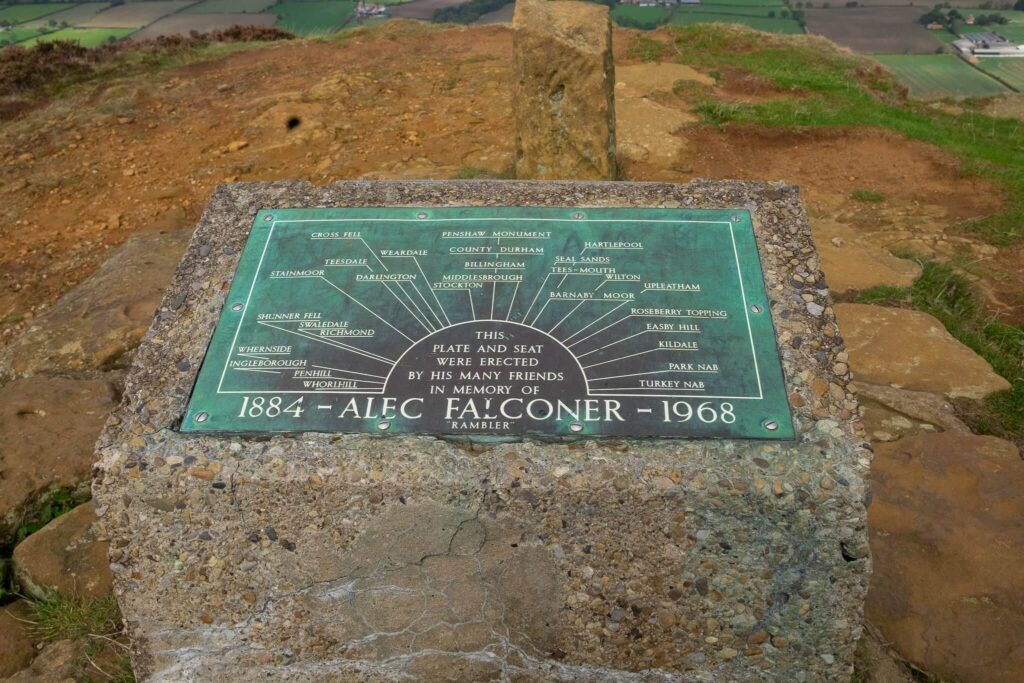
As the stone-paved section ended (I always wonder how the hell they manage to get these huge stone slabs up steep hills), a sandy coloured path led me along the flattened hilltop to the viewpoint. Here stands a stone bench (more so a stone armchair made for giants, providing a glorious windbreak). Just in front, there’s a large brass viewfinder mounted onto a tablet of rock – ageing to a fabulous teal colour – erected in memory of a local rambler.
After a few moments of being a little too whipped by the wind, and noticing the growl of my stomach, it was time for the gentle ascent back. Turning left I walked along the path with a beautiful, and no doubt ancient dry stone wall snaking along beside me.
Through the wooden bridle gate, I soon approached the same small forked junction I had initially taken, and proceeded straight ahead back towards the car park into the welcome warmth of the Lord Stone’s Cafe for lunch – muddy boots and all.
Tips for Walking the Lord Stone’s Circular:
- Although the walk is fairly short, bring some layers and a wind-proof rain jacket as the moorland is exposed and often very windy.
- Good water-proof walking boots are necessary for walking the muddy bridleway after rain.
- Make sure to visit the Lord Stone’s cafe for a post-walk refreshment (or for a Sunday lunch like me!)
- Although there is some steep gradient, the walk isn’t too challenging, so it’s a good one for kids. Those with mobility issues should take this walk at your own pace and bring a hiking pole.
- Dogs are allowed, but on leash only.
- Fancy staying nearby within the National Park? There are glamping pods and a campground at Lord Stones Country Park Camping.
Lord Stone’s Circular Walk Accessibility
Due to the gradient and terrain, the Lord Stones Circular walk is not accessible for wheelchairs or walkers, however the route to the three standing stones is possible with a good off-road chair. The Lord Stones Cafe is also wheelchair friendly.
All images credit of the author.
You may also be interested in this post about the best multi-day hikes in Yorkshire.