
Preferring food and box sets on the sofa to exercise, Jessica’s story of turning her life around and swimming the English Channel (and subsequently becoming a record-breaking adventurer) is as utterly moving as it is incredibly inspiring.
So, you swam the English Channel – why on earth did you do that?
I actually swam the English Channel in 2015 – which was before wild swimming became such a massive thing! It was the start of an adventure that has involved me swimming the Channel, running the London Marathon, and climbing Mount Everest – ‘the Sea Street Summit Challenge’. In fact, I’ve become the first (and currently) only woman to do all three of these things.
And my somewhat cheeky answer to why on earth I did it is ‘a lot of pain!’ After a series of difficult life experiences during my thirties (what I call my ‘pursuit of motherhood’ which involved going through multiple miscarriages and 11 rounds of unsuccessful IVF) I decided to try and swim my way out of sadness.
It turned into a journey that has changed my life!
So tell us, what was it like?
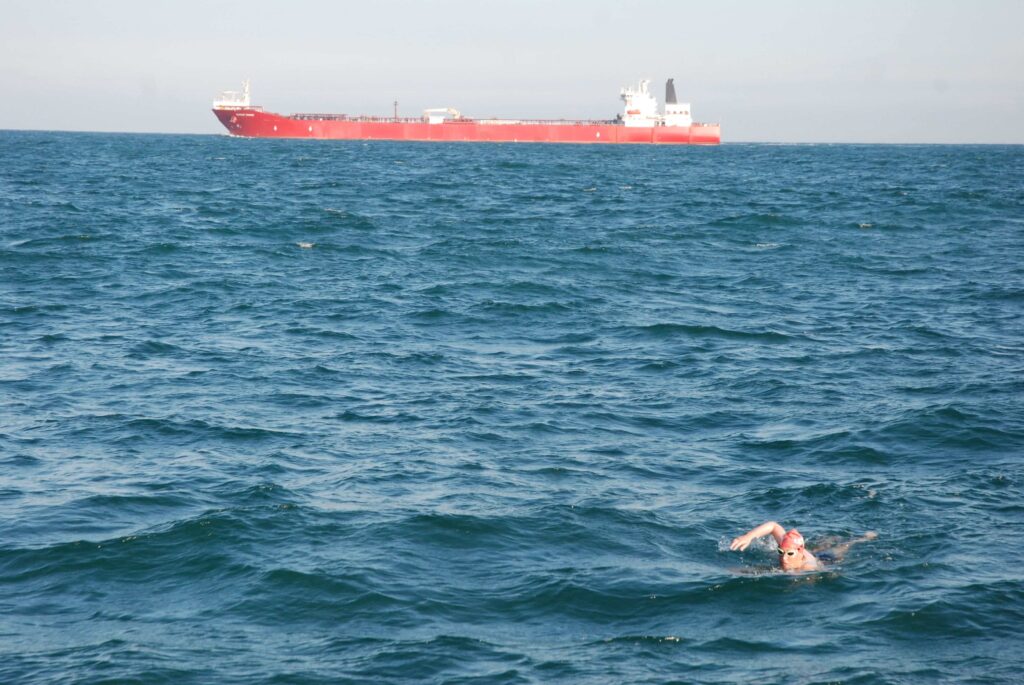
Well, the word I always use (and have become known for in the open water swimming community) is: AGONY.
When I started on my journey to swim from England to France, I had zero idea what was involved. I couldn’t swim very well. I hate the cold.
I had no idea that on average it takes around 15 hours and if you want to be an ‘official’ Channel Swimmer, you can’t wear a wetsuit. The reason? Captain Matthew Webb who was the first man to swim the Channel in 1875 didn’t wear one, so you have to adhere to the same conditions today. This means you can only wear a costume, hat, goggles and earplugs, and enduring the cold for hours on end is absolutely one of the hardest things about it.
I started from Samphire Hoe beach in Dover in the dark at 1.30am. You swim alongside a small support boat which steers your course and is there to fish you out if needs be.
I was very sick at the beginning – probably nerves – and my support team nearly aborted the swim as I couldn’t stop vomiting. Then in the separation zone between English and French inshore waters I was very badly stung by jellyfish. There were thousands of them – thick like oil slicks – and they stung me all over my body and face.
And finally – and this was possibly the hardest part for me – it took me five hours to land because I couldn’t break through the tide. I was so tired at this point and thought I was never going to get there. But eventually I landed on Sangatte Beach as the sun was setting. It took me 17 hours 44 minutes and 30 seconds.
I’ve described it as my own version of ‘giving birth’ – nearly 18 hours of pain and labour, which was eclipsed by euphoria when my feet touched the sand!
What training and planning did you do for swimming the English Channel?
One of the things I discovered when I started training is there wasn’t really a ‘manual’ for swimming the Channel – certainly not at the time. So I sought out advice, and was hugely supported by the Channel Swimming community who had swum the sea before me.
One of the very first things I did was go on a long distance swimming tour with the open water swimming company Swimquest on the beautiful island of Formentera in Spain. This was my first introduction to sea swimming and I managed about 10 minutes in the water.
Eventually I did my Channel qualifying swim with them too – for which you have to swim for 6 hours in water below 16C. I live in London and did all my home-based open water training at the Serpentine Lake in Hyde Park – the swimming club there has nurtured more Channel swimmers than any other open water swimming club in the world.
In the final lead up to my swim I also trained every weekend in Dover during the summer months under the watchful eyes of Freda Streeter MBE – the legendary swimming coach known as ‘The Channel General’. Freda has since retired but she’s been succeeded by Emma France who now runs Dover Channel Training which offers a fantastic service for aspiring Channel swimmers. I couldn’t have done what I’ve done without the support and wisdom of some amazing and kind people.
But I also had to put in a lot of work myself! I had to learn to swim the crawl (which I couldn’t) and during the winter months when it was too cold to swim in open water for any length of time, I would spend hours and hours doing drills up and down my local pool.
But because the cold is my nemesis, I also swam year round, getting in for just 5 minutes in freezing temperatures to face my fear. It took me around two and a half years between dreaming the dream of being a Channel Swimmer to achieving it.
You say you’re an unlikely athlete, why is that?
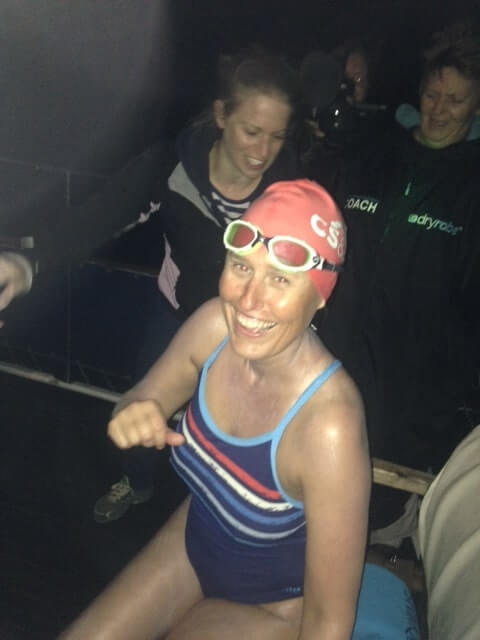
I have this conviction that when we’re children we’re often labelled as being a certain type of thing. There’s the ‘clever one’, the ‘naughty one’; the ‘arty one’, the ‘sporty one’. And I was definitely the ‘arty one’ and not the ‘sporty one’ (fyi I wasn’t particularly clever but sometimes I was a bit naughty!).
When I was little I wanted to be an actress and performed in all my school plays. But as I got older, I realised I wasn’t a very good actress (I’m only really good at playing me) so I ended up running a theatre instead. I was Chief Executive of the Lyric Theatre Hammersmith in London for a decade. I spent my evenings watching plays, and drinking wine at press night parties.
I didn’t go to the pool or the gym. In fact, I hate exercise. It seems to me the only reason to do it is for food, booze and box sets on the sofa.
But, as I said, after a series of hard and sad life experiences I started to exercise my way out of heartbreak. It changed my life. It’s made me a record-breaking adventurer. But I’ll always think of myself as an ‘unlikely athlete’.
Tell me about your highs or the most memorable moment during your challenge
One of the hardest things for me about swimming the Channel was discovering that, in many ways, it’s just like trying for a baby and going through IVF. That’s because nature decides whether you can conceive and carry a baby (doctors and medical science can help but they still can’t offer any guarantees). And nature also decides whether you can swim her seas.
It doesn’t matter how hard you train, or even how good a swimmer you are, if the sea doesn’t want you to cross her – you won’t.
When I realised this – some way into my Channel training – I was terrified. I was terrified that success was out of my control, and I might fail again – after so many years of failing at becoming a mother. So when my feet touched the sand in France it was the most unforgettable and healing moment.
And I know this might sound weird but I felt that nature loved me – after feeling for a long time that she didn’t. It’s something that I will never stop feeling grateful for, and it changed my life.
Tell me about your lows, how did you adapt or overcome them?

On the flip side of what I’ve just said, one of the hardest moments was when I discovered that success was out of my control. And this came the year before my solo swim when I attempted to do a Channel relay. This is when you swim it as a team, each person swimming for one hour before handing the baton to the next person.
We were a team of three and we set out from Dover and swam for several hours but then the weather turned terrible. Waves were crashing over our support boat. It was getting dangerous and we weren’t making any progress in the water and our boat pilot suddenly pulled the swim.
I remember sitting huddled in the hull feeling desperately disappointed but also a horrible feeling of dread that this might happen on my solo swim. It’s been a long process to come to terms with this feeling – of the fact that nature is in charge of some of the things I’ve wanted most in my life.
I also faced it again on my subsequent journey to the top of the world because nature is in control of whether you can climb a mountain too. I guess it’s been a journey of surrender and I think I have finally reached a point of acceptance that some things in life don’t go the way we want them to however hard we try, but that there is always gold in the dirt! You’ve just got to find it!
How do we find out more about your adventures?
I’ve written three books about my adventures through life – The Pursuit of Motherhood (2014), 21 Miles (2018) – which focuses on my Channel Swim – and is also the story of how I asked 21 famous women to meet and eat with me to help me get fat to swim the Channel and answer the question – does motherhood make you happy?
One of the great things about swimming the Channel is that because you can’t wear a wetsuit the only way to keep warm is a bit of human padding so it’s a licence to eat, and I love food!
I also have a new book coming out in March 2024 – Save Me From The Waves – which is an adventure from sea to summit. It’s available for pre-order now. And hopefully I’ll be back here soon to talk more about that!
Keep up to date with Jessica’s inspiring adventures via her website, Instagram, or grab a copy of her books, 21 Miles, The Pursuit of Motherhood, or pre-order Save Me From The Waves.
All images copyright of Jessica Hepburn.
Done Something Cool (Or Know Someone Who Has)?
Nominate yourself, or someone else to be interviewed about one of their UK adventures for our Adventurous People series.
What an amazing story. Turning something heartbreaking into a world-class adventure.