
There are few things more Scottish than rain, whisky, and midges – unless you throw wild mushrooms into the mix. In this mist-soaked, occasionally midge-infested account of the West Highland Way, Philip returns to one of Britain’s most iconic trails – and discovers a newfound love for the nation’s favourite tipple.
It was a dreich day in August when I saw my first ever chicken of the woods, nestled in the hollow of an oak in the southern Highlands.
It was one of the most colourful and surreal mushrooms I’d ever seen: a dense cluster of yellow fronds edged with pumpkin-orange brightness, almost – yet not at all – like a nest of eager lips, puckered up to kiss the sky.
“Oh yeah!” cried Ru, our designated mushroom-whisperer, “these are delicious.”
“Sure they’re safe?” his partner Nomes raised a skeptical eyebrow.
“Absolutely. Trust me, put these in a risotto, it’ll be a meal you never forget.”
And you know what? He was absolutely right.
It’s been more than three years since that day but I can still taste the creamy goodness of that risotto now. Cooked on a cheap camping stove and seasoned with salt from the crumbs of a crisp packet. Nevertheless, it was rich with the succulent, umami-rich flavour of the mushrooms. We forked it into our mouths while gazing at the mist on the rolling hills, sipping whisky from a flask.
I was on the West Highland Way, and the hot food and booze were helping to keep thoughts of the rain at bay.
Key Stats of the West Highland Way Walk
- Length: 154 km / 96 miles
- Duration: 6 – 9 days
- Difficulty level: Moderate to hard
- Type: Point-to-point
- Start/end location: Milngavie (near Glasgow) to Fort William
- Elevation gain: Approx. 3,155 metres
- Terrain: Forest tracks, lochside paths, gravel and tarmac roads, open moorland, rocky trails
- Accessibility: Unsuitable for wheelchair users and those with limited mobility
So Nice I Hiked It Twice
The West Highland Way (WHW) is one of Scotland’s most iconic long-distance trails, stretching from the outskirts of Glasgow to the foot of Ben Nevis in Fort William.
Winding through lowland pastures, old-growth woodlands, and vast moors before reaching the rugged Highlands, this 96-mile journey offers a stunning cross-section of the Scottish landscape.
I’m lucky enough to have walked the WHW twice. Once in 2021 and then again in 2023. Both times were around August but – as anyone who’s ever visited Scotland will know, summer brings no guarantee of sunshine. You could have fine weather and blue skies for the entire week (my first trip), or you could get stuck in three solid days of rain along the hardest part of the trail (my second trip).
I don’t mind telling you, the difference between those two hikes was stark. One was a mild stroll full of pub-visits and whisky distilleries, camping on bouncy grass every night; while the other was a savage slog through an interminable tangle of roots and muddy pathways, desperately trying to keep the gear dry while pitching a tent in midge-infested swampland.
So, if you’re planning a trip up north this summer, be sure to double and triple check the forecast – and be careful which apps you put your trust in. The Apple weather app tragically let me down. Instead, consider either the Mountain Weather Information Service (MWIF) or the Met Office app.
Alright, now that that’s out of the way, let me share a few of my tips and highlights across both my adventures on the West Highland Way. Note: this isn’t a step-by-step guide to the trail, it’s more of a general overview of what to expect and things to consider.
The Route: Like a Slow-Motion Roller Coaster
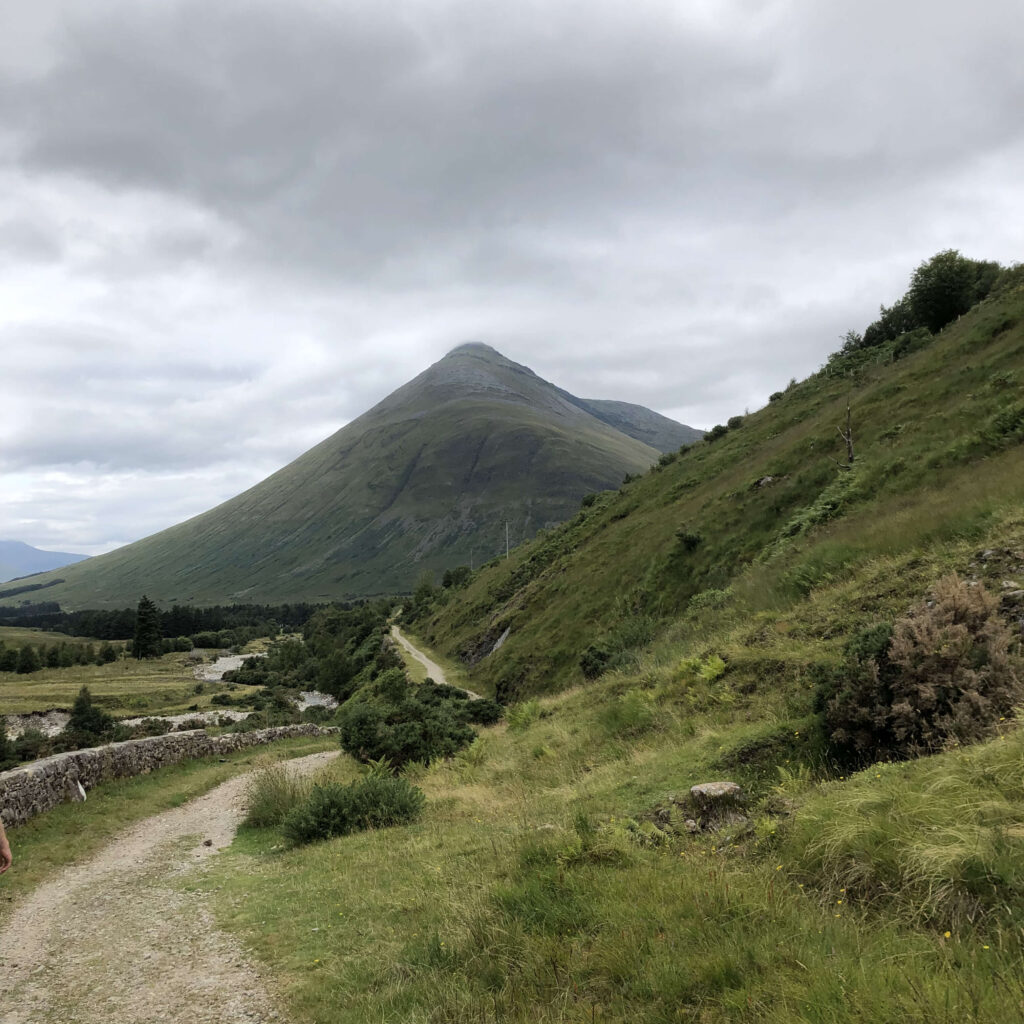
You’ll start the trail on the cobbled streets of Milngavie, just north of Glasgow. One of the great things about the WHW is how accessible it is via rail. So, if you’re getting the train to the start of the trail (and I highly recommend you do), simply change at Glasgow and hop on a train to Milngavie.
From Milngavie station it’s a short walk (sign-posted) through the high-street (useful for buying last minute supplies), until you arrive at the large ‘menhir’ stone, indicating the beginning of the trail.
From here you begin a long, slow-motion roller coaster of hills, hills and more hills.
The early stages mostly consist of flat-ish farmland, soft paths, and birdsong as you meander past Mugdock Country Park and into the Campsie Fells. This part is deceptive, as you won’t even feel the slight inclination that makes your pack feel twice as heavy.
It’s not until the second day, approaching Conic Hill and Loch Lomond, that the land begins to shift.
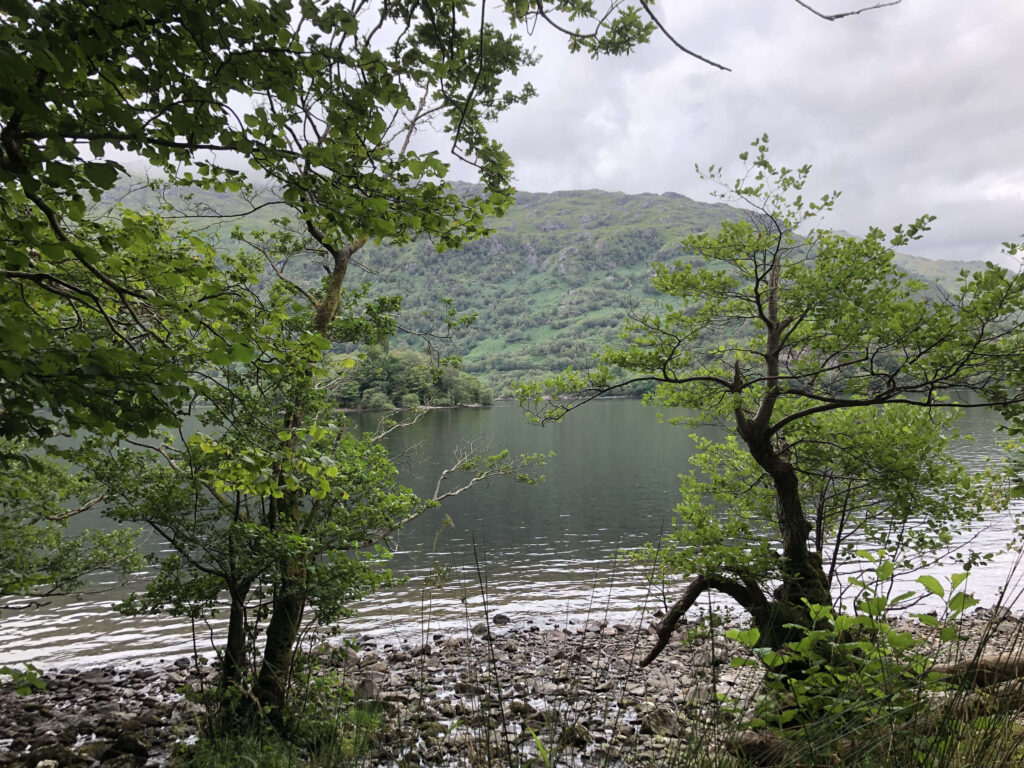
Climbing Conic Hill, with the shimmering loch below, will give you your first real ‘Highland moment.’ From the top, the view opens up to revel the next big challenge: the mighty but marvellous Loch Lomond, the UK’s largest freshwater expanse of water. For me, this was the toughest and the most beautiful stretch. The path through the old-growth oak forest is rooty, narrow, and distinctly magical.
On both trips – rainy and otherwise – I lost count of how many times I almost twisted my ankle or knocked my head on a low branch, but I also lost count of how many moments took my breath away. Sunlight flashing on the water, golden eagles circling above the trees, and nestled in the moss, the occasional delicious mushroom (as above).
Once you’re through the woods and past Crianlarich, the land opens out to more typical Highland scenery.
First, you pass through Rannoch Moor, a vast, boggy wilderness with few trees and little shelter. All very cinematic, if the sun is on your side.
Then comes the Devil’s Staircase, the notorious zigzag up toward Kinlochleven. The climb is long and steady, but if you find your rhythm and drink plenty of water (or better yet, whiskey?), you wont even feel it.
The descent into Kinlochleven is hard on the knees but softened by the knowledge that Fort William is now within reach.
The final stretch follows an old military road through Lairigmor, with Ben Nevis – Britain’s tallest mountain – growing larger with every step.
When you reach Fort William, be sure to make your way to the centre of town and have a rest next to the famous bronze statue of a fellow walker at Gordon Square.
Things to Consider: Whisky, Wildlife and Where to Camp
One of the best moments of both my trips, along with the mushrooms and golden eagles, was a visit to Glengoyne Distillery for a whisky-tasting evening. Until that day I hadn’t realised I was a whisky man at all, but the tour and tasting won me over completely. I came away with several small bottles to enjoy along the journey.
The distillery is right on the trail, about 8 miles north from Milngavie, and you’ll likely reach it on your first day. I’d definitely recommend a visit if you’re so inclined. Also, for the more hard-core whisky-lovers out there, check out the Whisky Trail – a luxury trip that takes you to nine major distilleries to appreciate the glory of Scotland, one dram at a time.
Next, wildlife. As I mentioned, one group of animals you’re almost sure to encounter on the WHW is insects. Specifically, midges. In summer they swarm like miniature clouds of locusts. If this sounds comical, believe me they are no joke. Be sure to take repellent, a midge net for protection, and have a look at the Scottish Midge Forecast before you set off. Also, ticks are a less frequent but more serious risk (they can carry Lyme disease), though I was fortunate never to encounter them
As well as insects, you’ll likely see all kinds of beautiful and unique wildlife, including rare red squirrels, golden eagles, ospreys, red deer, Highland cows and, if you’re very lucky, otters!
As for flora and fungi, there’s a wealth of things to see, from bluebells to orchids, and all manner of mushrooms. Note: obviously never mess around with foraging fungi if you don’t know exactly what you’re doing. And bear in mind there are plenty of deadly and toxic mushrooms in the UK.
Finally, on to one of the major highlights of the West Highland Way: Wild Camping!
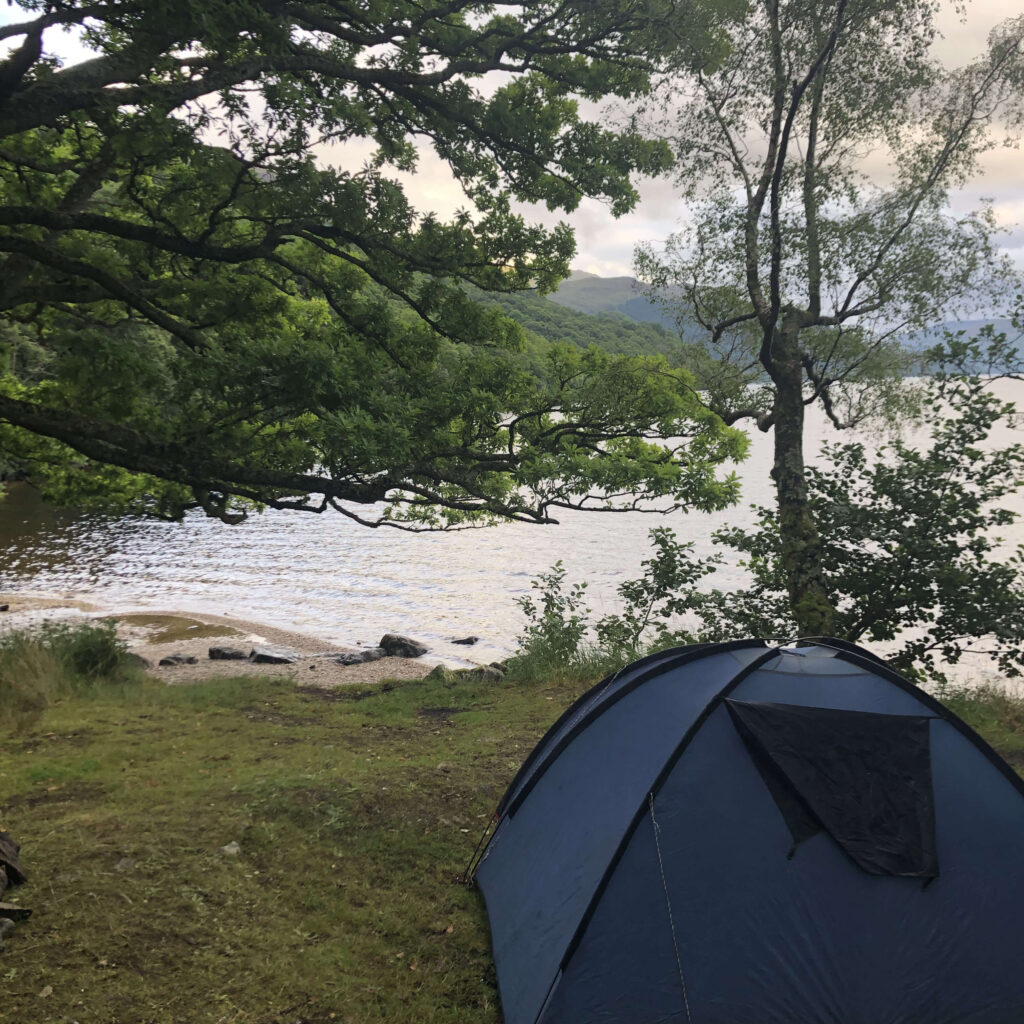
This is probably the real reason I walked the trail twice – and why I’ll likely do it again. The Highlands of Scotland are one of only two wild areas in the UK where you can legally wild camp. A subject that has recently come under fierce debate and is still an evolving and exciting conversation.
There are few feelings as wonderful as stepping out into the wilderness with everything you need on your back, finding a peaceful, beautiful spot and calling it home for the night.
Conclusion: A Walk To Remember
Walking the West Highland Way is absolutely one of the best, and most accessible, ways to appreciate the majesty of Scotland. For sure, there are more challenging routes to be found in the northern Highlands if you’re an advanced hiker. But if your wish is just to have a mid-difficulty adventure, filled with foot-sore freedom, landscapes that warm the eye and booze that warms the belly, then this hike is for you.
Tips For Walking The West Highland Way
- If choosing not to camp, be sure to book your accommodation early – hostels and B&Bs along the route fill up fast, especially in peak season (July to August).
- Once again, the section along Loch Lomond is beautiful but tricky – start early, take it slow and wear good boots.
- Consider breaking up the final stretch to Fort William with an overnight in Kinlochleven to savour the last leg.
- Many villages along the route have shops, but it’s still wise to carry snacks and refill water whenever you can.
- Beware, the midges can be fierce in summer – bring repellent and a net if you’re camping.
- Read up about ticks and the dangers of Lyme disease.
- If you fancy a dram, swing by the Glengoyne distillery just north of Milngavie.