
Whether it’s simply admiring the variety of birdlife in our own back gardens or holidays centred around finding endemic species to our isles, Brits are barmy for birdwatching. So grab your binoculars – here are some of the best bird life encounters in Britain.
According to Natural England, over 3.5 million people in the UK participate in some form of birdwatching or wildlife watching (and those are the people who actually admit to it!). Birds are simply emblematic of our countryside and wild outdoor spaces.
We’re fortunate that Britain has some absolute world-class birdwatching sites, including an abundance of nature reserves, national parks, and coastal areas, which offer opportunities to see a wide variety of bird species all year round.
With a long history of conservation, the UK has a strong network of organisations dedicated to protecting birds and their habitats such as the RSPB, making our home turf an attractive destination for bird lovers from around the world too.
So why not celebrate what we’ve got on our doorstep? There are some bird life encounters that are so iconically British, wildlife devotees should plan to experience them at least once in their lives.
Just not sure where to start? Here are some of the best birdlife encounters in Britain to experience, and some suggestions of where you can have them.
See Puffins in the Farne Islands by Boat

Puffins, often affectionately referred to as the “The Clowns of the Sea” are one of Britain’s most loved and iconic sea birds.
Round and stocky with a white belly and a black back, they’re almost a cartoon-like creature, but their most striking feature is by far their brightly coloured beak. Triangular in shape, the beak can be orange, red, and yellow with a blue-grey base, which gets particularly bright during the breeding season.
The Farne Islands, located off the coast of Northumberland in northeast England, are a popular destination for birdwatchers and wildlife enthusiasts to watch them.
Puffins arrive on the Farne Islands in early April and stay until late July or early August. The islands are home to several puffin colonies, with thousands of birds nesting on the cliffs and in burrows on the islands, so you’re almost guaranteed to see them.
Visitors can take a boat tour from the nearby town of Seahouses to observe the birds from a safe distance. Guided walking tours on the islands are also possible, which provide an opportunity to see puffins and other seabirds up close and learn more about their behaviour and habitat.
Whilst you’re there, look out for the colony of grey seals, which can often be seen lounging on the rocks or swimming in the surrounding waters.
Oggle at Osprey in Scotland
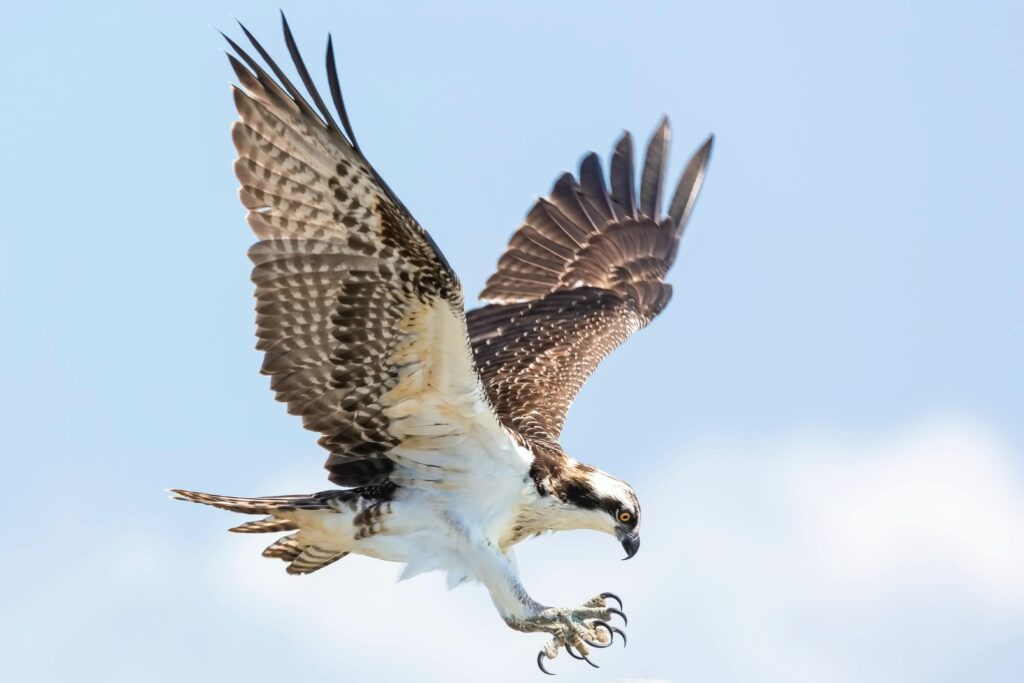
Scotland’s Cairngorms National Park is a prime location for spotting ospreys in the Spring to late Autumn, when these magnificent birds of prey typically migrate to the UK from winter spent in West Africa.
Ospreys are known for their impressive fishing skills, diving into the water to snatch fish with their sharp talons, sometimes even up to three times their own weight!
As well as their sharp talons and dive bombing behaviour, ospreys can be identified by their brown and white feathers and distinctive black hooked beak.
A species considered extinct as a breeding bird in the British Isles in 1916, thanks to conservation efforts, there are now a predicted 250-300 breeding pairs. Hooray for osprey (and those who’ve worked hard on their reintroduction)!
Visitors can now watch ospreys nesting from hides at Loch of the Lowes Reserve, at Loch Garten Osprey Centre in Abernethy, on a guided tour or, if you’re lucky, just out and about in the national park on your Scottish adventure.
Watch Red Kite Feeding in Wales

Historically, the red kite was a common bird of prey in the UK, but by the 20th century, they were animals on the brink of extinction due to hunting, persecution, and habitat loss. But a reintroduction program in the late 1990s was one of Britain’s biggest bird success stories as today there are over 1,800 breeding pairs.
Red kites have a distinctive reddish-brown body, with a forked tail that is deeply notched, giving them an unmistakable appearance in the sky. They’re also known for their aerial acrobatics, often soaring high and performing graceful twists, turns and tumbles.
Unusually, red kites are scavengers, their diet consisting mainly of carrion, but they also eat small mammals, birds and reptiles.
Littered across Wales are many red kite feeding stations and centres, such as Gigrin Farm, a working sheep farm located in Rhayader, Powys, home to the Red Kite Feeding Centre. Visitors to the farm can watch up to 600 red kites being fed daily, and there are several hides for birdwatching.
If you’re exploring the great public gardens of Wales, work in a visit to the British Bird of Prey Centre at the wonderful National Botanical Gardens of Wales.
Go Nightjar Watching at Dusk in the New Forest

Nightjars are found in heathland and woodland habitats, and the New Forest provides the perfect environment for these birds to breed and raise their young.
The most common species of nightjar found in the UK is the European nightjar, which is a medium-sized bird with mottled brown and grey plumage. They have pointed wings and a small, but broad beak. Nightjars have large eyes that are adapted to low light conditions, allowing them to hunt insects such as beetles, moths and flies during the night.
Males make a “churring” call during the breeding season as part of their courtship by rapidly vibrating their throats, creating a sound that can carry for long distances across the forest.
The best time to see nightjars in the New Forest is during the summer months, from May to August, when the birds are most active and visible in the summer night sky. A guided walk with a local expert at dusk when the birds become active, is the best way to spot them, as they are easily camouflaged.
Avoid breeding season when females lay eggs on the forest floor to minimise disturbance as they usually lay on a bare patch of earth or sand, which they incubate for 3-4 weeks.
Track Down Scottish Crossbills in the Cairngorms

Although hard to determine due to their elusive nature, there are said to be only a few thousand Scottish Crossbills in the country which can be found only in Scotland. Considered a vulnerable species, they’re protected under the UK’s Wildlife and Countryside Act.
The Scottish Crossbill is a member of the finch family. They’re a small, somewhat plump bird, with a distinctive crossed bill that it uses to extract seeds from the cones of pine trees. Its plumage is mainly red or orange on its head and breast, and its wings are a dull brown-grey.
Most commonly found in the Caledonian pine forests of Scotland, the Cairngorms National Park comes up top here (again) for one of the best places to see Scottish crossbills. So grab your walking boots, a pair of binoculars and head into the depths of the pine forest.
They’re fairly social birds and so typically found in small groups, and their presence is often given away by their distinctive call, which sounds like a sharp “jip-jip”.
Spot Common Kingfishers in Herefordshire
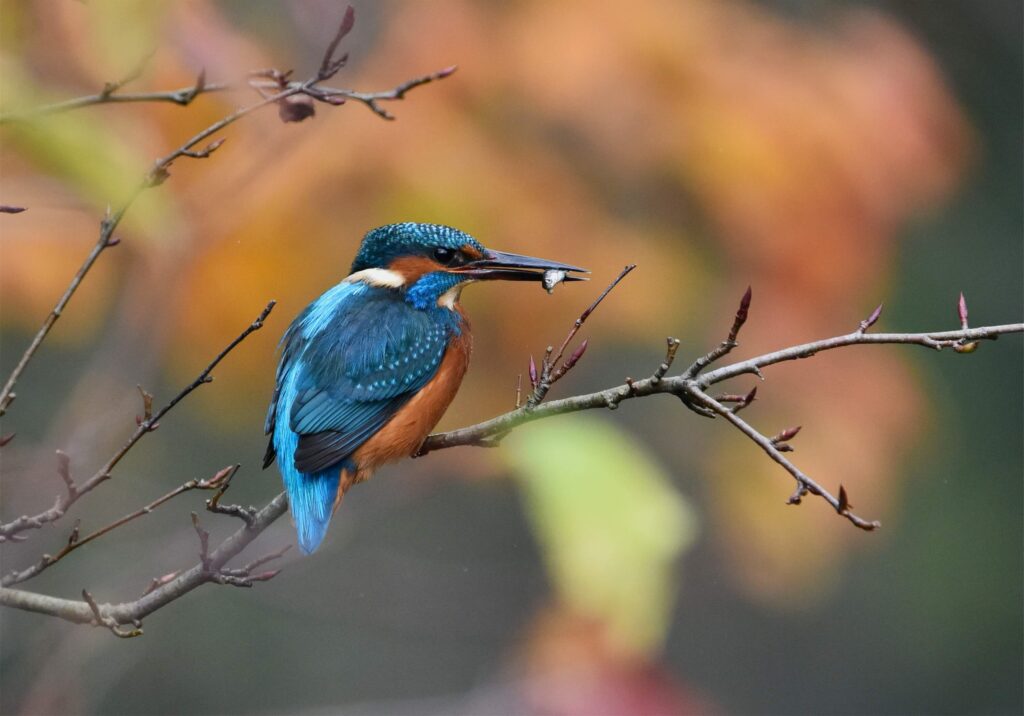
Blink and you’ll likely miss them – a flash of electric blue is probably all you’ll see of this almost tropical looking small river-dwelling birds. But if you’re quiet and it’s your lucky day, there’s nothing more satisfying than seeing an elusive kingfisher in the wild, albeit possibly for only a few seconds.
There are three species of kingfishers that are found in the UK: the common kingfisher (which despite its name is the most striking), the pied kingfisher, and the occasional sighting of the belted kingfisher.
A large head, a long, pointed bill and specialised vision allows them to see their prey (small fish) through the water, and dive at a high speed to catch them, even in low light conditions.
The River Wye is known as one of the best places in the UK to see kingfishers. The river flows through the beautiful Herefordshire countryside, and visitors can spot these birds from several viewpoints along the river, usually on slow moving or still sections.
Your best bet of tracking one down may well be listening for their distinctive high-pitched call, which they use to communicate and mark their territory to other kingfishers.
We know it’s a given, but wherever you have these bucket list birdwatching encounters in Britain, always follow guidelines for responsible wildlife viewing to minimise disturbance to the birds and other wildlife. This includes staying on designated paths and viewing areas (especially as ground nesting birds and their eggs can be hard to spot), keeping a safe distance from nesting birds, and avoiding any actions that could cause the birds to flush or abandon their nests.
So, where are you off to first?